Providing Novel Therapies that Work Better, Have Fewer Side Effects and are Easier to Use than Currently Available Treatments
Galimedix is developing amyloid beta (Aβ) aggregation modulators as oral and topical drugs for the treatment of several pervasive and devastating diseases. Our technology has the potential to alter the course of disease, preventing blindness in patients with dry AMD or glaucoma and slowing or even stopping disease progression in patients with Alzheimer’s disease.
Convenient, noninvasive administration via oral tablets or eye-drops ideally suited to the needs of patients.
Excellent clinical safety and tolerability of GAL-101 eye drops and oral formulation demonstrated in Phase 1
Dual action: removal / clearance of toxic Aβ oligomers resulting in neuroprotection & functional improvement
Targeting misfolded monomeric amyloid beta (Aβ) allows for the removal of the whole spectrum of possible toxic Aβ oligomers
-
Topical GAL-101 in dry AMD: A Potential Game Changer in Phase 2 Trial with Strong Partner
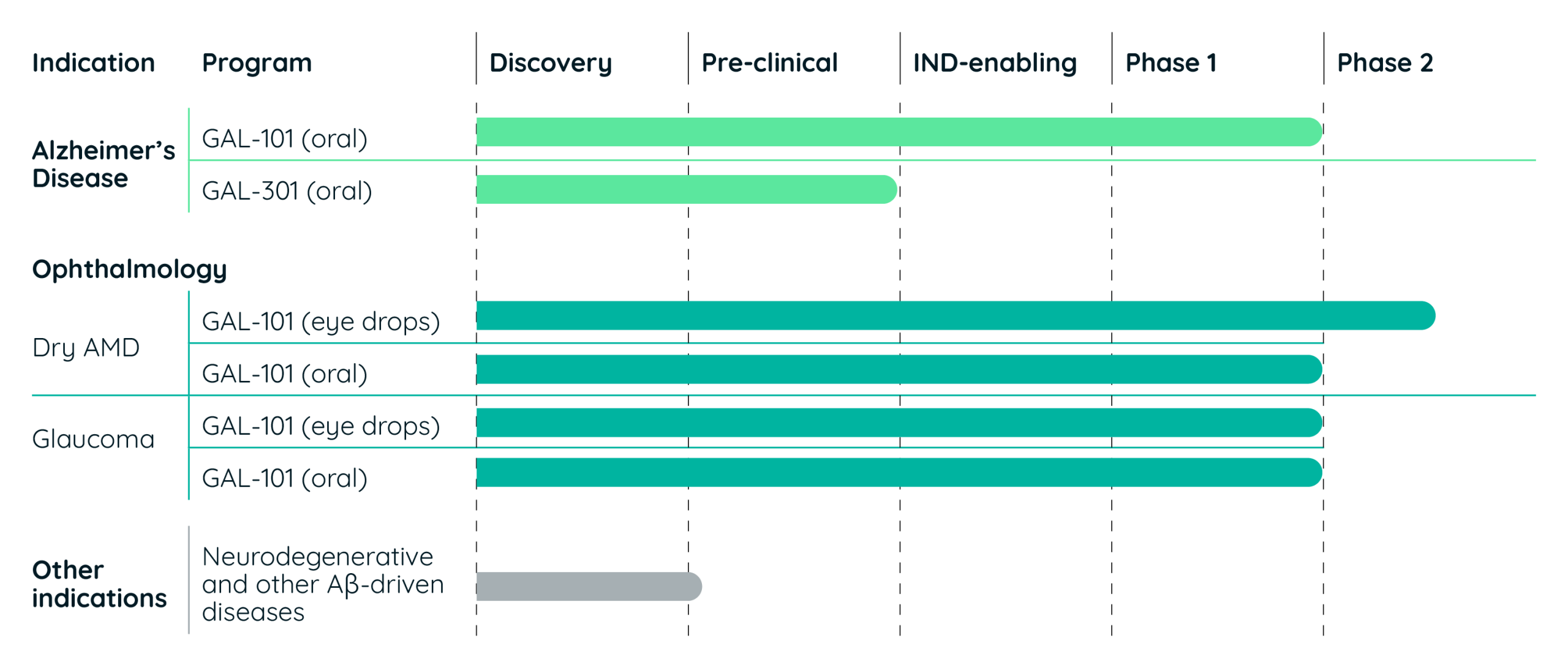
GAL-101 is Galimedix’s most advanced compound and is currently being evaluated in a Phase 2 clinical study, called eDREAM, for the treatment of geographic atrophy, an advanced form of dry age-related macular degeneration (AMD). Dry AMD is one of the leading causes of adult blindness.
Delivered topically as an eye drop, GAL-101 is designed to provide a patient-friendly treatment, targeting toxic Aβ in the retina. An oral formulation of GAL-101 has completed successfully clinical Phase 1 development.
GAL-101 has demonstrated compelling efficacy in relevant ophthalmic pre-clinical models: the eye drop formulation has been shown to effectively deliver GAL-101 to the retina, its intended site of action, and to protect neuronal retinal cells from toxic damage.
eDREAM (NCT06659549) is a Phase 2 clinical study evaluating GAL-101 eye drops in non-foveal geographic atrophy (GA), an advanced form of age-related macular degeneration (AMD). AMD affects more than 200 million adults and involves degeneration of the retina, the light-sensitive tissue at the back of the eye. GA is an advanced form of AMD in which certain areas of the retina slowly lose photoreceptors, the cells that allow us to see. At first, the damage usually appears away from the center of vision. Over time, the damaged area grows and can reach the fovea, the part of the retina responsible for sharp, central vision. When this happens, everyday activities like reading, recognizing faces, or driving become severely impaired/limited.
Phase 2 eDREAM Trial Investigating the Potential of GAL-101 Eye Drops to Improve and Maintain Patients’ Vision Longer
With our Phase 2 eDREAM clinical study we want to find out whether GAL-101 eye drops can slow or stop the growth of these damaged areas, helping to preserve vision for as long as possible and prevent the disease from reaching the fovea. In addition, we will test whether treatment leads to early improvement in vision.
Up to 110 patients with GA will be enrolled in the study at clinical sites in the US, Armenia, France, Georgia, Germany, Ireland, Israel, and Italy.
Over a period of at least 12 months, patients will apply the eye drops daily and attend regular clinic visits to measure vision and retinal sensitivity to light, check whether the area affected by GA is growing and monitor overall eye health.
Learn More About the eDREAM Study
For more information on the eDREAM study, please contact Luciana Summo, Ph.D., info@galimedix.com or visit clinicaltrials.gov.
We believe that GAL-101 has the potential to revolutionize the treatment of geographic atrophy, an advanced form of dAMD. With the eDREAM trial, we look forward to further evaluating the non-invasive eye drop treatment candidate and delivering on our goal of helping people living with GA to maintain their vision.

Luciana Summo, Ph.D.
VICE PRESIDENT, R&D OPERATIONSIncreasing Evidence Supports the Role of Toxic Aβ Species in the Pathogenesis of AMD, a Leading Cause of Adult Blindness
A growing body of evidence highlights the significant role of Aβ oligomers in retinal diseases, including their involvement in the pathogenesis of AMD, a neurodegenerative disease of the eye that affects around 200 million patients worldwide and has emerged as the leading cause of adult blindness in the US and other industrialized countries. Multiple studies link toxic Aβ species with key stages of AMD progression and support its role in driving degenerative processes in the aging macula.
Limited Treatment Options and Dry AMD Growth Call for Practical Solutions
Most people (around 80–90%) with AMD have the ‘dry’ form of the condition, an early stage in which retinal cells in the central area— the macula—slowly degenerate. Over time it may lead to geographic atrophy, a late stage associated with advanced vision loss.
Dry AMD has been a challenging-to-treat disease. Today, repeated ocular injections, which are burdensome for patients, are used. However, they do not lead to an immediately recognizable benefit for the patient, which poses a problem for the motivation to continue this stressful treatment for the long term. Therefore, there is still a high medical need for new
Stages of AMD
Learn more:
Pre-clinical data in dry AMD show clearance of toxic Aβ in the retina, the key to restoring functionChronic topical treatment with GAL-101 solution (0.5% or 2%, 3 µL, 3 times a day for 3 months) decreased the heavy deposition of Aβ along the retinal pigment epithelium (RPE) / Bruch’s membrane (red staining) in 24-month-old C57BL/6 mice – a murine model of AMD. Interestingly, as a consequence, the hyperactivation of complement C3b (green staining), which is co-localized with the Aβ deposits, is also reduced markedly, even though GAL-101 has no direct affinity to C3b.
Solid Phase 1 safety results pave way for Phase 2 clinical trials in dry AMD and further ophthalmology indicationsA Phase 1 safety study with GAL-101 eye drops was successfully completed in 40 healthy subjects and 30 glaucoma patients as a randomized, double-blind, placebo-controlled single center study. All subjects received GAL-101 eye-drops over 16 days up to the maximum dose possible, i.e., thrice daily three drops in a row with 5-minute intervals using either placebo solution, 5 mg/ml GAL-101 (0.5%) or 20 mg/ml GAL-101 (2%) in an ascending dose regimen.
The results of this study demonstrated an excellent safety and tolerability profile of the GAL-101 eye drops and the Phase 1 study protocol was accepted by FDA and considered sufficient to support the start of larger clinical studies in glaucoma and dry AMD patients.
-
Toxic Amyloid Beta (Aβ) Leads to Vision Loss in Glaucoma
Glaucoma, a leading cause of irreversible blindness worldwide, is characterized by the progressive death of nerve cells that transfer visual information from the eye to the brain. While commonly linked simply to the effects of raised intraocular pressure (IOP), a growing amount of data suggest the disease shares common pathogenic mechanisms with other neurodegenerative conditions, such as Alzheimer’s disease, strongly associated with the formation of toxic Aβ oligomers. Multiple studies implicate Aβ in the development of the characteristic progressive retinal ganglion cell (RGC) apoptosis and consequential disconnection of the eye from the brain.
Many Patients do not Benefit from Current Treatment Options
Although drug, laser, and surgical incision treatments are available to address glaucoma, all current approaches work by lowering IOP. However, many glaucoma patients do not have elevated IOP: The majority of Asian glaucoma patients and an estimated 20-30% of patients in the Western World experience so-called normal tension glaucoma (NTG). Particularly for these patients, today’s regimens result in very limited efficacy.
Additionally, even in a significant subset of glaucoma patients with elevated IOP and subsequent treatment, glaucoma-related vision loss continues, despite IOP lowering.Stages of Glaucoma
Topical GAL-101: Creating a New Treatment Paradigm to Fulfill Substantial Unmet Need
With over 90% neuroprotective efficacy shown in relevant glaucoma pre-clinical models, Galimedix’s Phase 2-ready compound GAL-101, holds great promise to be the first glaucoma therapy that directly addresses the disease via neuroprotection, providing an option for the many patients for whom treatments alleviating IOP are ineffective. Delivered as an eye drop, it is designed to be a convenient and safe treatment and thus ideally suited to slowing the progression of chronic diseases like glaucoma, in which long-term therapeutic efficacy is dependent on patient compliance over many years.
An oral capsule formulation of GAL-101 is also in development.
GAL-101 has demonstrated compelling efficacy in relevant ophthalmic pre-clinical models, protecting neuronal retinal cells from toxic damage, and an excellent safety and tolerability profile in Phase 1 testing.
Over 90% Neuroprotection Confirmed in Animal Models of GlaucomaGAL-101 has been tested extensively in pre-clinical models of glaucoma, such as the Morrison rat model, in which acute episcleral vein occlusion with hypertonic saline leads to IOP. In control animals, this elevated IOP caused about 20% of retinal ganglion cells (RGCs) to die within 3-16 weeks, whereas less than 1% of RGC’s died in animals treated with GAL-101, whether administered via eye drops (2%, 3µL), subcutaneous (60-240 mg/kg) or intravitreal (0.1 mg/ml, 3 µL) injection.
In repeat experiments, independent laboratories reproducibly obtained over 90% neuroprotection, correlating with reduced optic nerve degeneration, despite an elevated IOP, and showed a sustained effect from single day treatment of over 6 weeks.
Phase 1 Successfully Completed Showing Excellent Safety and Tolerability Profile, Paving the Way for Further Fevelopment in Ophthalmology IndicationsA Phase 1 safety study with GAL-101 eye drops was successfully completed in 40 healthy subjects and 30 glaucoma patients, in a randomized, double-masked, placebo-controlled single center study. All subjects received GAL-101 eye drops over 16 days up to the maximum dose possible, i.e., thrice daily three drops in a row with 5-minute intervals using either placebo solution, 5 mg/ml GAL-101 or 20 mg/ml GAL-101 in an ascending dose regimen.
The results of this study demonstrated an excellent safety and tolerability profile of the GAL-101 eye drops. All 70 randomized subjects completed the study and adverse events occurred at low frequencies across the treatment and control groups. As with preclinical experiments, no influence of the drug on IOP was observed, and no interaction with IOP lowering treatments was seen. Plasma concentrations were barely detectable, establishing a comfortable safety margin compared to the animal toxicology studies.
-
Therapeutic Strategies Targeting Amyloid Beta (Aβ) Bring Breakthroughs in Fight against Alzheimer’s Disease (AD)
While the causes of AD are still not fully understood, one hallmark of the condition is the accumulation of protein deposits in the brain called Aβ plaques. After decades of failed drug development attempts, recent approvals based on statistically significant, clinically meaningful Phase 3 data with Aβ-targeting antibodies (aducanumab, lecanemab, donanemab) have marked a new era in treating this debilitating disease, validating the importance of toxic Aβ oligomers and protofibrils as a key target.
However, while progress has been made with the introduction of these Aβ-targeting antibodies, they also have notable safety issues and a challenging route of administration, resulting in a remaining medical need for more efficacious, safer, and easier-to-use treatments for the 55 million people worldwide living with AD.
Oral Small Molecule GAL-101 Designed to Overcome Limitations of Current Therapies
To avoid known pitfalls of today’s drugs, Galimedix is developing the small molecule GAL-101, belonging to a new pharmacological class of Aβ aggregation modulators that act upstream of most other Aβ-targeting agents.
In contrast to antibodies that eliminate toxic oligomers only after their formation, require parenteral administration and have poor access to the central nervous system (CNS), GAL-101 is specifically designed to address Aβ before it turns into toxic oligomers. In pre-clinical testing, GAL-101 has been shown to prevent and eliminate all forms of toxic Aβ species while leaving healthy Aβ forms intact. GAL-101 also has shown the potential for neuroprotection and for symptomatic alleviation in pre-clinical models of AD. Additionaly, orally available GAL-101 has shown no antibody-specific immunological side effects (e.g., ARIA), very low systemic toxicity, robust storage stability, and easy and inexpensive manufacturing.
Phase 1 Trial Shows Excellent Safety, Tolerability and Pharmacokinetic ProfileThe compound has recently completed a Phase 1 clinical trial that enrolled a total of over 100 healthy volunteers and evaluated the safety, tolerability and pharmacokinetics (PK) of single (SAD) and multiple (MAD) ascending oral doses of GAL-101. The study also evaluated GAL-101’s ability to cross the blood-brain barrier, as well as a variety of other parameters, including the effects of food, age and gender, all of the relevant aspects required to initiate Galimedix’s planned Phase 2 study in Alzheimer’s disease.In the trial, GAL-101 was shown to be well tolerated and clinically safe, with no serious adverse events (SAEs) observed. Consistent with pre-clinical findings, GAL-101 was shown to effectively cross the blood-brain barrier, and its PK profile strongly supports advancing the oral formulation in Phase 2 development in Alzheimer’s disease.Robust and Consistent Pre-Clinical Data Support Advancing GAL-101 as AD TreatmentGAL-101 has shown strong pre-clinical potential as a treatment for AD. It exhibits high selectivity and affinity for binding misfolded Aβ monomers, crucial for its therapeutic effect. Pharmacokinetic studies have demonstrated the ability of GAL-101 to reach the brain after oral administration, achieving effective concentrations that improve cognitive function in AD animal models. GAL-101 not only prevents Aβ-induced toxicity but also reverses established damage, suggesting robust neuroprotective and cognitive restorative effects. These promising results support the potential of GAL-101 as an effective oral treatment for AD.


